Plug In, Press Record, Go Broke: The Hidden Math Behind Canada's Home Studio Boom
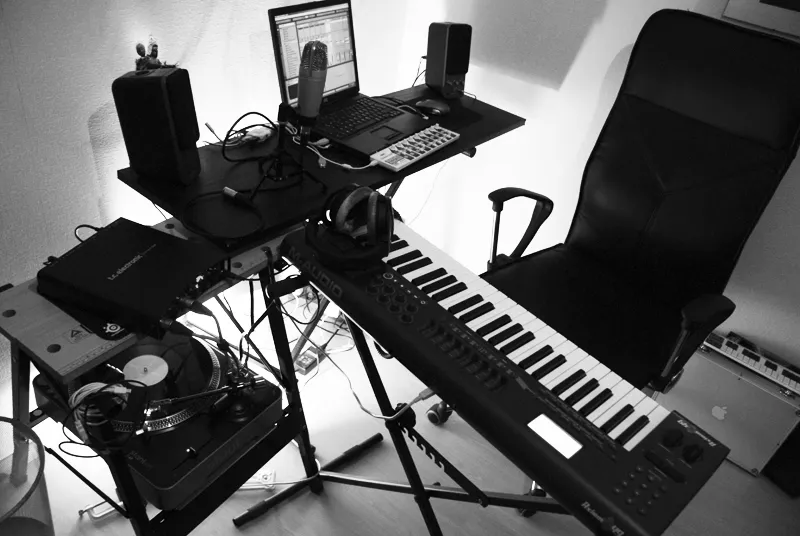
Photo: LiquidMolly, CC BY-SA 2.0, via Wikimedia Commons
There's a version of the story that sounds almost too good. A kid in Saskatoon downloads a DAW, picks up a second-hand MIDI controller from Facebook Marketplace, staples some moving blankets to the wall, and starts making music that sounds — honestly — pretty decent. No label. No booking agent. No $300-an-hour studio bills. Just talent and a laptop.
That version is real. It happens every week across this country.
The part nobody talks about is what comes after the first three months of excitement, when the novelty of infinite creative freedom bumps into the very finite reality of trying to pay rent.
The Democratization Myth (And Why It's Only Half True)
The idea that affordable technology has levelled the playing field in Canadian music is not wrong, exactly. It's just incomplete. Logic Pro costs less than a hundred dollars a year. An entry-level audio interface runs you under two hundred. Splice gives you access to thousands of sample packs for the price of a streaming subscription. Compared to what it cost a Canadian artist to get professional-grade recordings made in 1995, the savings are staggering.
But here's the thing about a level playing field: when everyone has access to the same tools, the tools stop being the differentiator. What you're left competing on is everything else — mix quality, mastering, distribution strategy, marketing, playlist pitching, sync licensing relationships, and the kind of industry connections that still, frustratingly, don't come bundled with GarageBand.
The barrier to recording has dropped dramatically. The barrier to breaking through has barely moved.
What the Gear Budget Doesn't Cover
Talk to any working Canadian producer who came up through the bedroom studio route and they'll give you a version of the same list. The stuff that actually costs money isn't the interface or the monitors — it's everything that comes after the session ends.
Mastering, even through online services, runs anywhere from $50 to $200 a track if you want it done properly. Hiring a mixing engineer — because yes, most artists eventually learn that their own ears aren't objective enough after hour six of staring at a waveform — can run $300 to $800 per song from someone reputable. Then there's music video production, EPK photography, publicist fees if you want any press coverage, and the distribution platforms that actually get your music onto Spotify and Apple Music in the first place.
None of that includes the cost of the courses, YouTube rabbit holes, and trial-and-error years most bedroom producers spend just learning how to make their recordings not sound like they were tracked inside a shoebox.
The result is a strange paradox: Canadian artists are making more music than ever before, and fewer of them are making a living from it.
The Oversaturation Problem Nobody Wants to Name
Distrokid and TuneCore have made it possible for virtually anyone to upload music to every major streaming platform within 48 hours. That's genuinely remarkable. It's also created a situation where roughly 100,000 tracks are uploaded to Spotify every single day — and Canadian artists are contributing their share to that flood.
When supply is essentially infinite, the economics get ugly fast. Streaming royalties that were already thin have become almost meaningless for artists without massive catalogue volume or playlist placement. Getting editorial playlist consideration requires pitching at least seven days before release through Spotify for Artists, which requires planning, consistency, and a track record — things that bedroom producers who are still figuring out their sound often don't have.
The artists who are making bedroom production work as a career are largely the ones who figured out that the studio is only one part of a much larger operation.
What's Actually Working
The Canadian artists navigating this landscape successfully tend to share a few common traits. They've stopped thinking of themselves purely as musicians and started thinking like small business owners. They diversify — sync licensing for film and TV, commissioned production work for other artists, Patreon or Bandcamp subscription models, and live performance revenue that actually moves the needle.
Programs like FACTOR (the Foundation Assisting Canadian Talent on Recordings) offer funding for recording, marketing, and touring that can meaningfully offset some of these costs — but the application process is competitive and not exactly intuitive for a first-time applicant still figuring out what a proper budget breakdown looks like.
Some artists are finding that collaboration is the cheat code. Splitting sessions between a bedroom setup for tracking and a professional studio for mixing and mastering gives you the creative freedom of DIY production without the sonic compromises. It costs more than pure DIY, but it costs a fraction of what a full studio album would have run a generation ago.
Others are leaning into community. Producer collectives in cities like Montreal, Toronto, and Vancouver are pooling resources — sharing high-end microphones, outboard gear, and most importantly, knowledge. The learning curve on bedroom production is steep; it's considerably less steep when you've got five other people who've already made the same mistakes.
The Gap Is Real, But It's Not Permanent
There's no clean ending to this story, because the situation itself is still evolving. The bedroom producer problem isn't going away — if anything, it's going to intensify as the tools get better and more accessible and the volume of music being made keeps climbing.
What's shifting is the sophistication of Canadian artists' approach to it. The ones who are treating the home studio as a starting point rather than an endpoint, who are learning the business as hard as they're learning the craft, who are using available funding and building genuine industry relationships — those artists are finding a path.
It's just not as simple as the gear ads make it look.